The increasing interest in peptide therapies among clinicians has highlighted the significance of understanding the nuances between different compounds. Ipamorelin and Sermorelin have emerged as prominent contenders in this arena, particularly within medical research. Each peptide boasts unique characteristics and potential benefits, but making an informed choice requires a deep dive into their specific attributes.
This guide focuses on providing clinicians with a detailed comparison of Ipamorelin and Sermorelin, examining their mechanisms of action, safety profiles, and application in clinical settings. Clinicians need to consider several factors, including clinical endpoint achievements and adherence to Good Clinical Practice (GCP) guidelines, to make the best choice for their research or practice.
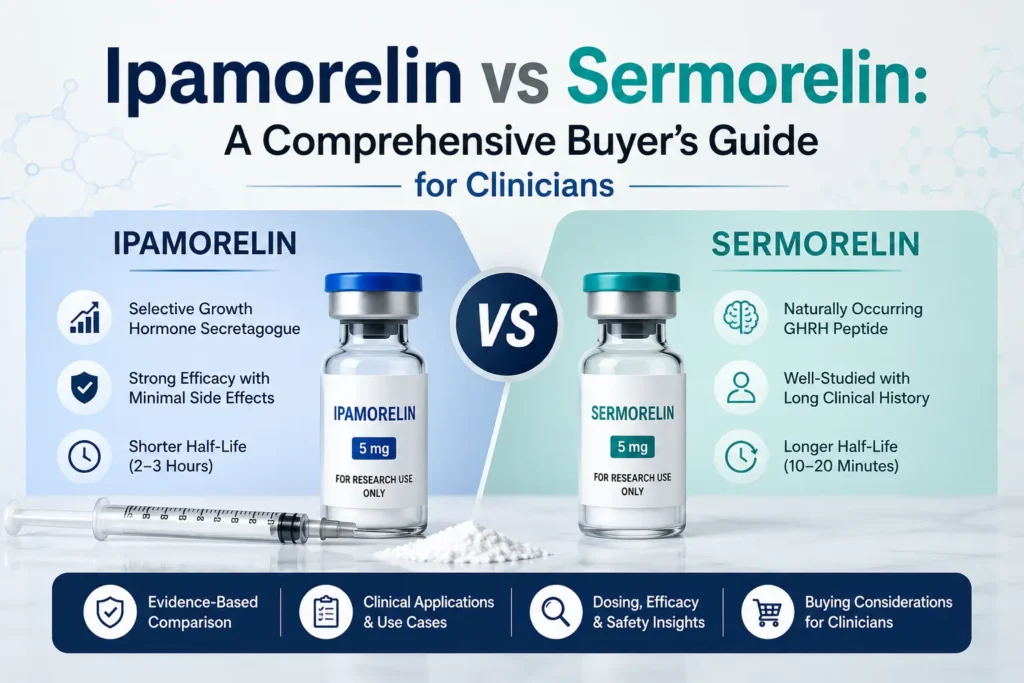
Understanding the primary differences between Ipamorelin and Sermorelin is crucial for clinicians involved in medical research. Ipamorelin is a selective growth hormone secretagogue, meaning it specifically stimulates the release of growth hormone without significantly affecting other hormones. This selectivity often makes it a preferred choice in Phase I/II/III Clinical Trials where precision is paramount. On the other hand, Sermorelin, a growth hormone-releasing hormone, acts on the pituitary gland to increase the natural production of growth hormone. It has been widely studied for its effects on aging and growth deficiencies. In fact, the comparison of Ipamorelin vs Sermorelin is often made when evaluating their effectiveness in clinical practice.
From a research perspective, the choice between Ipamorelin and Sermorelin may depend on the specific clinical trial objectives. For instance, a biostatistician might prefer Ipamorelin for studies focusing on targeted outcomes, while Sermorelin could be selected for broader applications involving hormone regulation. Clinicians should also consider consulting the Institutional Review Board (IRB) to ensure ethical compliance and review the Investigational New Drug (IND) Application processes when planning their research.
The mechanisms by which Ipamorelin and Sermorelin operate are central to their clinical applications. Ipamorelin functions by mimicking the ghrelin hormone, which is known to stimulate growth hormone release, and it does so with minimal side effects. This action is particularly beneficial in randomized controlled trials (RCTs) that require a narrow focus on growth hormone activity without unwanted interactions. Conversely, Sermorelin’s action through the pituitary gland makes it suitable for studies evaluating broader hormonal improvements or deficiencies, often used in contexts of aging research and growth hormone deficiencies.
For clinicians, using a Clinical Trial Management System (CTMS) can enhance the management of studies involving these peptides, ensuring that protocol deviations are minimized and that data is accurately captured and analyzed. Furthermore, employing biomarker validation techniques can help in assessing the effectiveness of these peptides in achieving desired clinical endpoints.
The safety profiles of Ipamorelin and Sermorelin are critical considerations for clinicians. Ipamorelin is generally well-tolerated, with a low incidence of side effects, making it an attractive candidate in early-phase clinical trials where safety is a predominant concern. Sermorelin, while also considered safe, may present with more varied side effects due to its broader hormonal impact.
Pharmacovigilance plays a key role in monitoring these effects, and clinicians should be diligent in adverse event reporting, ensuring all occurrences are documented and reviewed by a Data Monitoring Committee (DMC). The informed consent form (ICF) must clearly outline potential risks, allowing participants to make informed decisions.
Deciding between Ipamorelin and Sermorelin involves evaluating the specific needs of the clinical research or treatment goal. For instance, a study published in the Clinical Trisals Registry highlights how Ipamorelin’s selectivity can be advantageous in trials requiring precise growth hormone modulation. Conversely, Sermorelin may be preferable in settings where a broader hormonal impact is beneficial. Clinicians must consider the sample size calculation and study design, ensuring that the chosen peptide aligns with the research objectives and participant demographics.
For further insights into dosage recommendations and administration protocols, the resource Ipamorelin vs Sermorelin provides comprehensive guidance. This can be invaluable for clinicians looking to optimize their research outcomes effectively.
Conclusion
Choosing between Ipamorelin and Sermorelin requires careful consideration of their unique properties, safety profiles, and applications. Clinicians must leverage available research tools and adhere to regulatory guidelines to ensure successful outcomes. By understanding the specific attributes of each peptide, clinicians can make informed decisions that align with their research goals and contribute to advancements in medical research.
I am Indian Blogger, Here I provide you best information on my OPGYAN.com blog. I have also obtained master's degree. I read everything very widely and on the basis of that knowledge I give all the information here.